Friday, June 15, 2007

By Juan Riera


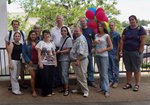
Today is the last day of field school, which has gone by way too fast.

We all think it has been a great experience. Although some good friendships have been started, it is a bittersweet day as we all part ways. A lot of interesting discoveries were made, but due to the short nature of the field school I am sure of future opportunities at this site for fieldwork; hopefully if it happens, it won't take another twenty years.


Although the field school is over it is just the beginning of many other aspects of this dig. Next week lab work and analysis of what has been found will begin. This will entail among other things the cleaning and sorting of artifacts. The principal investigators of this project will also begin work on the publication of the results. On a more practical level, next week will focus on cleaning tools and materials and putting back into storage items that belong to the FSU Anthropology Department and items that belong to the Florida Bureau of Archaeological Research.

Thursday, June 14, 2007


By Erin Bailey


I think most of us were ready to close our units as we neared the last levels of sterile soil, but Paul and I are still working on our bisection to get a better idea of the profiles of the two features (the trench and possible posthole) and their matrix. However, the post hole-like area continued to a depth where it became too difficult to spoon out, especially since we are only removing one half of it. At about 70 cm, it appears that we have hit the bottom of the trench.

During our recent Public Day event, I was asked several times about what was to come of our units once field school ended. Although it was not formally addressed, I knew that it is not unusual for a well-documented excavation to be back-filled, and doing so probably protects it to an extent. It has been decided that the fill dirt will come from the small, modern mound just north of the parking lot, which needs to be screened anyway, so by screening it directly into our units, we will be accomplishing these two tasks simultaneously.

It is so close to the end of field school that conversation has shifted from what we have found in our units to how we might best keep in touch with each other. After seeing these guys as often as I see my husband and devoting seven hours a day to a hole in the ground, life will soon be very different as I head back to campus, and it is hard saying goodbye to the project.

Wednesday, June 13, 2007


By Erin Bailey


As if any other day here was normal, today was an interesting one. It began with a morning quiz, followed by a visit by an AP reporter and yet another photojournalist, Phil Coale, whom I happened to have worked with in my previous life in photography. Having been photographed by two of my former colleagues in the last week of fieldwork, I can really appreciate what this change in career has done for me. Imagine waking up to a new day of great exercise, an industrious and close-knit team, and new discoveries every day!


While our blogs might sometimes seem to overly emphasize every activity as a learning experience, most of it truly is revealing. The AP interview was a good lesson in choosing one’s words carefully (to “think before I speak”), as journalists speak volumes to the public. They tend to ask questions with professional intent, which is why they keep a recording device on hand. It is easy to forget this when they seem so down-to-earth, which is what I almost did.


Paul and I started on our unit at a depth of 55 cm today, not really knowing what to expect, as we had just come upon reversed stratigraphy only yesterday. This basically means that the soil was upturned when it was dug up and then re-deposited with the oldest material on the top and newer material in the stratum below. While we were still finding potsherds at this level, our trench-like feature running down the center of the unit was finally coming to its end, graduating into the same color soil as its matrix.


At this time, however, a dark spot on the east wall, which we once considered a root discoloration, began to look more and more like a posthole as we bisected it, the trench, and the surrounding stratum from east to west. The soil from it was collected and will be floated as a method of determining if it is, in fact, a posthole.


Jennifer and Evan’s unit is sterile at 85 cm. Mercedes, at 80 cm in her unit, reports, “We haven’t found stuff forever.” Juan and Mary were happy to have found flakes, a gaming stone, large potsherds with designs, and intact brick in theirs.
Tuesday, June 12, 2007


By Mercedes Harrold


The days of the field school are winding down and we are trying to carefully finish up the units open and study the artifacts left in our buckets of dirt. Today I was FS Tsarina once again and spent my day in the water screening area and although not as hot as it was yesterday, the water screening is a nice respite from digging.


Today was fairly interesting. Rain was forecasted (not abnormal in our Florida summers), but no rain came, although early on the overcast skies were starting to make us wonder. We were able to have a successful day digging and screening. Paul and Erin continued on their feature and interestingly enough the colors of their unit became inverted by the end of the day…their orange clay feature had turned to a darker, mottled gray brown and orange color of soil, while their dark areas surrounding the feature turned a strong brown color (see below). A possible post hole may have been found in their unit too. So, they plan to excavate only half of the post hole, taking it down 10 centimeters. By excavating half of the feature we get a profile of the features shape. Since the posthole is so small, the spoons will be broken out tomorrow for that extra special digging.


Tomorrow is going to be a very productive day starting with our final quiz. I’ve been told that the most exciting archaeological finds always occur on the last few days. We will see if the blessing (or the curse) of a new find will happen within the next few days.

Monday, June 11, 2007


By Jennifer Futch


Today was the hottest day we’ve had yet; it was over 100 degrees in the middle of the day. Luckily, the unit Evan and I have been working in is at least partially shaded by trees. We still have not come across any features at 65 cm, but we’re still finding artifacts. The ground is getting very hard as we get deeper and deeper into the clay.


Because of the heat, we stopped excavation a little early and found some other chores that needed doing.

Public day on Saturday was a huge success. I tried my best to explain FS numbers, provenience (where the artifacts originate from), and archaeological context as I washed artifacts. Everyone seemed very interested in seeing the artifacts we had been excavating over the past few weeks. I really enjoyed teaching the public about archaeology.

I’ve been so immersed in school and field school over the past year, I have been taking my understanding of archaeology for granted. It was really enjoyable to share it with people from the community. This was especially rewarding because my station was about aspects of archaeology that people don’t often think about, like archaeological context and lab work.

As the end of our field school gets closer, we’re working even harder than before. We will get as much done as we can before the end of the week.

Saturday, June 9, 2007


by Juan Riera


Today the Florida State University (FSU) Anthropology field school, in conjunction with the Florida Bureau of Archaeological Research (BAR), sponsored a public archaeology day, featuring the Martin/de Soto site. It was attended by close to 400 members of the community. I spoke with a couple from Virginia, who learned so much and enjoyed themselves so immensely that they asked for directions to Lake Jackson Mounds and Mission San Luis, other Tallahassee archaeological sites, which, like the Martin/de Soto site, are stewarded by the state.

Eight activity areas and displays were planned, designed, and carried to fruition by the field school students, which focused on the Martin/de Soto site dig. These included survey, excavation, and artifact screening and processing demonstrations; a children’s activity station; atlatl spear throwing; an exhibit on zooarchaeology (the study of non-human animal remains in archaeological contexts); and two displays respectively highlighting the scientific method in the discovery of the Martin/de Soto site and Apalachee pottery and society.

We were joined by architectural historian, Dave Ferro, who gave well-attended tours of the Governor Martin House (the air conditioned building was a welcomed relief to the 100 degree weather outside). Local artist Doriann Martin (no relation to the Governor) brought her Apalachee ceramic replicas, showing a video on how she employs traditional firing techniques in their fabrication. Louis Tesar and Kevin Porter of BAR drew a lot of attention for their knowledge of and ability to flint knap (i.e., make stone projectile points). Adjacent to them we had Jamie Levy with his Cracker horse, Aceituna (Olive), appropriately named for the horse ridden by de Soto and a descendant of this early breed. There was also a 300 pound, taxidermied, wild pig, since de Soto introduced pigs to North America, making him the father of the modern US pork industry. We were further joined by Eric Holdos, who used his blacksmithing skills to create a Spanish breast plate, soon to be displayed at the Martin House. Members of the Panhandle Archaeological Society at Tallahassee (PAST) rounded out the event with free cookies and beverages for the crowd.

Overall, a good time was had by Juan (and I mean one) and all.

Friday, June 8, 2007

by Paul Williamson


Today was an incredibly busy day. The focus was on preparing our display stations for tomorrow’s public day and tidying the grounds for visitors. This morning Erin and I cleared around one excavation unit northeast of the parking lot for easy visitor access, while everyone else raked dead brush behind the Martin House, which is where we plan to set up the displays.

Other issues also had to be addressed, such as coordinating with the following groups: the Park Service, whose rangers manage the property; the local archaeological society, Panhandle Archaeological Society at Tallahassee (PAST), whose members will be pitching membership and providing refreshments; and the Division of Historical Resource (DHR), whose related staff, primarily archaeologists and conservationists, likewise will be presenting exhibits and running activities to fill out the public day. There was also concern about our “staff” t-shirts, which we will all be wearing tomorrow, provided the embroiderer finishes on time. Additionally, there are the obvious but often overlooked items, such as chairs, tables, signage, and literature for distribution that are essential to a successful public event, which we needed to get ready.

Our instructors have been valuable in helping us prepare for tomorrow, having been previously involved in many public outreach events. Andrea has skillfully guided the students’ projects to ensure they are not only informative and truthful, but also fun. Mary’s good at logistical trouble-shooting and keeping people on task.

All in all, everything is coming together. Let’s hope we have good weather for Saturday!


Thursday, June 7, 2007


By Jennifer Futch


Yesterday was exciting for a while in our excavation unit; at 50 cm we discovered what seemed to be a feature in the northeast corner and an area in the southwest corner. However, they each disappeared after only a few centimeters of digging. Looking at our walls we can see that uneven stratigraphy caused our false feature and area. We are still wondering why we have not found a feature yet when our unit is so full of pottery and daub. Today Evan and I brought the unit down to 65 cm with no features still. Again, there were a lot of pot sherds and daub but no features. It’s interesting that we still have not hit sterile soil, or soil without artifact or human disturbance, at such a deep level. I can tell we are getting better at excavating; we are digging our levels much faster and easier every day.

Tomorrow we will all be cleaning up and preparing for our public day on Saturday. We’ll all be very busy getting ready! My station will be the “Artifact Lab” where I’ll be cleaning artifacts and teaching the public about what happens after artifacts are excavated. Hopefully we’ll have a good turn out.


Wednesday, June 6, 2007


By Michael Birt


I spent the day in the pool. Not a pool filled with water, rather a pool filled with dirt where we are water screening all of the soil that comes out of the units. Although I was not excavating in the units, I did get to see some amazing finds. This morning Michelle and I found small iron fragments of what has the potential of being pieces of chain mail. Later, Michelle found an almost undeniable piece of chain mail. We are fairly positive it is a fragment of chain mail worn by one of de Soto’s men, making it an exciting find. Mercedes made her way down with the last half bucket of dirt left over from yesterday. She dumped the dirt into the screen and I ran my hands over the top of the dirt, I saw a bone sitting on the screen. Michelle confirmed that it was the left tibia of a small mammal.

A film crew from FSU came down to the site today around 9:00 AM to videotape what we have been doing over the past couple weeks. While Michelle and I played in the water elsewhere on the site people were excavating. Paul and Erin continued to work around Feature 1, a large trench. They ended excavating at a depth of 45 centimeters below datum. Jennifer and Evan uncovered to a possible feature and area. Unfortunately they appear to be root stains. Mercedes, Moe, and Juan continued excavating around a very large root. When the root was removed they found a large stone preform. Moe and Juan also laid down two more units which we planning on opening up tomorrow. Nothing to exciting happened in the afternoon hours. The pool area was filled with screens holding dirt and artifacts to sift through. The others continued to dig and bring bucket loads of dirt to the water screening area. Only two more days until Public Day and we are trying to get the units to look pretty while at the same time preparing our individual stations. Until tomorrow I bid you ado to you, and you, and you.

Tuesday, June 5, 2007


By Mercedes Harrold


It seems that since hurricane season began on June 1, the rain, which we had so greatly needed, has come…and now it does not seem to want to stop.

This morning, the future archaeologists carried the minimum amount of tools they needed out to their excavation units and Michelle and I headed toward the water screening area because once again I was the FS Tsarina. This means that I am responsible for keeping
track of all the soil from various excavation units as it was screened. By the time we all got situated, the clouds opened up and we had to run everything back inside because the rain.

We did not waste the day though. We were divided into
groups and five of us had the task of cleaning artifacts that had already been given a field specimen number. The other students were given tasks in preparation for public day this Saturday.

During the cleaning process, we each had a small tub of water and a toothbrush to brush off the dirt. We were very careful during the cleaning process because some artifacts, like daub and animal bones, are more fragile. These were not cleaned with water. The pottery was cleaned carefully also and only the edges were brushed to see the clay tempering.

We had a special treat at lunch today because the State Archaeologist provided all of us pizza. We were all very appreciative of the special treat and enjoyed each other’s company over our pizza and soft drinks.

After lunch the rain let up so we headed back out into our respective units and Michelle and I headed back out to the water screening area. Within a few minutes there were several buckets full of wet dirt. Since everything was wet, we had to wrangle up some more screens for drying the small materials recovered in the 1/16th screen.

The rain stayed away the rest of the day although we did end up having to hurry up the task of putting away equipment after finding out we were under a tornado warning.

Monday, June 4, 2007


By Samantha Schlazer


Today, we started off with a few sun showers. We thought it was going to continue to rain and we would have to go inside, but it let up real quickly. Mercedes, Juan, and I are working on the same unit as Friday, over on the east side of the parking lot. We are not really finding that many artifacts, but I found one large piece of pottery this morning. I was sick today, so I was trying to take it easy. Juan carried all the buckets and did a lot of the screening for our unit; he said that they found some aluminum fragments from an old toothpaste tube which indicates our unit is slightly disturbed. Mercedes and I noted lots of charcoal flecks throughout our unit. We were very excited this afternoon when Paul came over with his chainsaw and removed two large roots from our unit.

Regarding other units, Paul and Erin found a really cool feature in their unit, so it will be exciting to see what they uncover. Already this unit has generated small pieces of iron which may be fragments of early Spanish chain mail (pictured left). Examples were sent to the conservation lab to be assessed by the Bureau’s conservator.

All in all work is going really well. Everyone seems to be getting along well and pitching in to complete the tasks assigned. I hope we are able to get to all six or seven of the potential excavation units by the end of the field school.

Friday, June 1, 2007


By Paul Williamson


Friday, it was a good day for us. We are learning to excavate our units more efficiently. The digging partners from the survey test units were shuffled around some. There are currently three excavation units open with two to three people working on a unit and one person overseeing the water screening. The two graduate students are working where needed from moment to moment. Everyone rushes to be of service when someone needs something. I was able to work in the unit with the clay feature that Sam and I uncovered a week ago (pictured to right). The clay feature (see below) runs the entire two meter length of the excavation unit

and seems to be circular, which is very exciting because we know that the Anhaica Apalachee homes were built in a circular fashion and that they used clay for not only the walls but also the floors. We only uncovered the feature today and will do more on Monday.

Everyone has now decided on what they want to contribute on Public Day next Saturday. We want it to be informative as well as exciting and memorable for everyone.

One of the bad things about working in hard clay that we did not anticipate was how quickly our shovels would become dull. To combat this dire problem, everyone stopped early today, grabbed a file, and set to sharpening tools. Andrea allowed us to practice with the atlatl for a few minutes (an atlatl is a piece of wood designed to make throwing a spear much easier) and, believe it or not, no one got hurt! With about five throws apiece for ten students at twenty meters, the only people to pierce the target were Moe and Michelle (the two graduate students).

Wednesday, May 30, 2007


By Michael Birt


Another sweltering, hot day in a hole, unless you are water screening, which allows you to cool off. Fortunately for the excavation partners, Evan and Jennifer, we had so many buckets to water screen from yesterday it kept us cool for the first hour or so. Then it was back to the hole and the heat. We finished leveling out the floor of our unit N5014 E5023 and found a strip of what appeared to be daub. Andrea helped us use a trowel to scrap off the top layer of dirt to “clean up” the floor of the unit so we could photograph it after lunch. Although it does not seem very exciting we learned a great deal today. Being that our unit was the first unit opened at the Martin/de Soto site for this summer’s field school, Andrea is able to use it as a model for all other units opened this season. Today we learned about mapping the floor of a unit. Mapping is when you use two tape measures and a plum bob to make a scale drawing on graph paper. Today we used this method to map our floor. When mapping a floor it is called a plan map, a map from a bird’s eye view. The clumping of the daub in the middle of the unit was designated as Area 1. We did not have enough evidence to call it a feature, but it was distinctly different. We took Area-1 down another five centimeters by itself because we determined it was intrusive to the soil matrix around it. Unfortunately this area only held a thin layer of daub imbedded in the soil matrix. Inside Area 1, however, we did find a rather large piece of metal, a wire nail, and Spanish pottery.

Elsewhere around the site, Paul had his hands full all day over at the water screening area. Luckily Moe was there to help Paul. Paul was in charge of handing out all the Field Specimen numbers so that all artifacts could keep their provenience. Paul was also in charge of making sure the soil from all the units was placed in the proper screens so that artifacts from one unit do not get mixed up with those from another. Erin and Juan finished their final shovel test and moved onto opening up the third unit this afternoon. Michelle, Mercedes, and Sam opened up the second excavation unit this morning and worked throughout the day to get through their first arbitrary level of ten centimeters. All in all it was a productive and knowledgeable day.

Tuesday, May 29, 2007


By Mercedes Harrold


This morning we began with a lecture about the procedure for our unit excavations. Up until this point we have been digging 50cm by 50cm shovel tes
ts and today we are going to start 2 meters by 1 meter units to check out possible features we found earlier during our shovel testing. Our math skills, learned many years earlier (and I thought long gone) would now be used again: the good old Pythagorean Theorem. We use the theorem to figure out the hypotenuse, or diagonal dimensions of the excavation unit. This ensures that our excavation unit is perfectly square and not rhombus in shape. We also have the total station to make sure the corners of our unit, our northings and eastings on our site grid, are correct.

Right before lunch, Erin and Juan continued their shovel test by the Martin house. Unfortunately Mary and my shovel test that looked promising on Friday had been bombarded by fire ants. Instead of finishing it today, Jennifer and I prepared for the water screenin
g by carrying the screens-the ¼ and 1/16th inch screens down to the old pool, where we will be screening the soil from the units.

Just before lunch we began water screening a large pile of soil left in the woods from the earlier excavations. We wanted to use this soil as back fill for our excavation units. We had been told the soil had previously been screened, but we wanted to test it to make sure. Paul, Jennifer, Michael, Evan and I took the hoses and screened the dirt through the ¼ screen just to get a feel of the water screening process. After lunch we began the real water screening on our first one by two meter unit, excavated by Michael, Evan, and Jennifer. Two of them dig at a time, while one screens with me because today I was the FS Tsarina….or the mistress of the field specimen empire. Pretty nifty, huh? I am in charge of keeping track of all of the soil that is screened out of the excavation units.

We finished screening level one of their excavation unit and began to put away our dig gear for the day. We look forward to opening up more units in the next few days and seeing what the earth is holding as well as finding more pottery from the Apalachee Indians or maybe even remnants from Hernando de Soto's expedition
.

Friday, May 25, 2007


By Paul Williamson


Out of the smoke they walked, with their weapons of mass earth investigation in hand. They are the true unsung heroes of movies like Apocalypto. They are Archaeologists. Working tirelessly, day after day for little pay, removing dirt a fraction of an inch at a time to depths of several feet, sweating profusely in the hot sun, slapping at ants, ticks, and mosquitoes, the archaeologist’s job is not one for everyone. Archaeologists do their work because they want to preserve the past for all future generations. The archaeologist carefully excavates and records the archaeological record (what people in the past leave behind) and uses the data to reconstruct prehistoric (before the written language) and historic cultures.

There are many highs and lows from day to day in the field. For example, yesterday we found many interesting soil anomalies that are indicative of past human activity (called features), and even a nice, intact projectile point. We have decided to expand the shovel tests with features to create formal excavation units. Today, while completing shovel testing , we tested near the Martin House and found many Native Indian potsherds (broken pieces of pottery). Alas, they were jumbled together with modern glass, roof tile, and a broken piece of brick from the house construction in the 1930’s, rendering them of little value in interpreting the early occupation of the site. Despite the mixed provenience of the artifacts, everyone feels optimistic about the next three weeks of field school.

On Tuesday we will begin excavating the larger units. We all wish for rain to soften up the baked clay ground and help extinguish the raging fires in northern Florida (the smoke from the fires was the worst it has been today and after eight hours in it, my eyes are fatigued and ache). Aah, the life of an Archaeologist!

Thursday, May 24, 2007


By Evan Heiser


Today we started our second to last day of shovel testing. Next week we will open up a few excavation units from existing shovel testing pits. These units will be significantly larger than our shovel test pits which are only 50cm x 50cm (about 1.5 x 1.5 feet). The larger units will most likely be one meter by two meters (3 x 6 feet). This size will enable us to actually get into the unit and excavate whereas our shovel testing pits are just too small. We should have more leverage with the shovel and other tools which will make digging much e
asier. Michael and I opened up a new hole which is located at N5040 E5040. This pit is located on the northeast side of the property in the woods near our neighbor's backyard. Before actually starting excavation, we had to clear away the modern trash on the surface. A lot of ivy covers the ground, so we took a shovel and cleared the top layer away from our testing pit so that we were not sitting in vegetation. We were careful not to walk into poison ivy. Michael started digging while I sifted through materials. The top couple of soil layers, about 20cm (8 inches), was fairly easy to dig through since the dirt was a silty loam, conducive to vegetative growth. Our finds for the first layer consisted of a modern nail and staple, many small pieces of charcoal, a modern piece of ceramic, and a few pottery sherds. Our second layer was the most exciting given it produced our most interesting artifact yet uncovered.

At about 18-20cm below surface I ran across a point while sif
ting through the subsoil. My first reaction was one of denial but I soon realized how cool the find was. Michael immediately took the point around to the other members of our field school to show it off. Everyone seemed to like the find. Louis Tesar came over to analyze it and said the point can range in date from 1650-1820 and belonged to the Mississippian culture. The point was made from a type of chert which is located along a creek bed in Alabama. The point is 2.2cm in width at the base and 3.6cm in length. It has color gradations which range from dark yellow, medium brown, and medium orange. The point may have been located at the layer that Native Americans lived on. I have never personally found anything like it. The feelings associated with it are kind of strange. A part of me wanted to hang onto the point so I could continue to look at it and rub it, but that is obviously not the ethical thing to do. By keeping it with the collection, Archaeologists can learn far more about the past by studying the point and the associated artifacts and soil deposits. There is just something strange about handling an artifact which was made a few hundred years ago by someone who really needed it. Touching the surface and looking at all the flakes really allowed me to understand the how skilled the workers must have been. Touching the point brought me back in time for a few minutes. Michael and I dug down another three layers to 50cm (20 inches) below the surface. In layers three and four we found a few artifacts which consisted of pottery sherds and fired clay accretions. We ended the day by recording the stratigraphic layers of our testing pit and then backfilling it. Tomorrow we should move onto another pit located in the woods on the southwest side of the property.

Earlier in the morning Andrea called us over to take a gander at Michelle and Mercedes' hole which was located only 10 meters south of ours. While digging they ran into a possible feature only about 25cm (10 inches) down. The feature covered about 70% of their excavation unit and ran from the south wall to the north wall. It was partially covered by a large root in the southeast corner of the unit. The feature resembled hardened clay and contained charcoal flecking in it. The flecking has been a common theme throughout several pits and should be indicative of past areas of pottery production or living spaces. Juan, Erin, Paul, and Samantha have continued working on their test pits but I don't think they have come across anything out of the ordinary. Towards the end of the day Moe and Jennifer left their hole to shoot some more points with the total station. The total station is a very expensive EDM (electronic distance measuring device) surveyors and archaeologists use to plot points from our datum. Moe would shot points while Jennifer balanced the rod housing three prisms responsible for receiving the laser from the total station. Andrea cleared the area of brush so that the laser would not be obstructed. Tomorrow should be our last day of shovel testing and then next week we will move onto larger units.

Wednesday, May 23, 2007


By Michael Birt


It is as though Evan and I had once again stumbled into a shovel test composed of hard clay; little did we know this hole would be our most exciting yet. It was slow going, digging through hardened compacted clay. It felt like trying to dig through concrete with a shovel. Evan managed to excavate the soil in our shovel test down to around 45 centimeters (18 inches) below the surface. I was screening the dirt coming out the hole, a process which archaeologists shift dirt through a screen in order to recover small artifacts (pictured right). Evan recovered several pottery sherds. Upon close inspection we noticed that the pieces fit together to make one larger sherd which appeared to be the rim of a vessel or pot. Directly below the sherds, Evan noticed a dark stain or discoloration in the clay that contained pieces of charcoal. This dark stain or feature could possible be the remains a posthole. Andrea inspected our find and determined we were going to suspend or stop excavation. We will open a larger excavation unit next week to further explore the feature. Evan and I mapped the shovel test, a process of making a scaled drawing of the wall(s) and/or the floor. We then lined the four walls with plastic and roped off the hole for safety.

Meanwhile across the site in Paul’s shovel test, he found a large animal tooth, possibly belonging to a cow. About ten centimeters (4 inches) or so below the tooth, Paul uncovered a linear feature where there was a line of distinction between two different soil colors (pictured left). At another shovel test nearby, Michelle and Mercedes found yet another feature at the end of day, five minutes before we began cleaning up. The possible feature was evident by a linear soil discoloration. There were so many discoveries across the site today; everyone had an exciting day under the hot sun.

We also began planning for the upcoming and Public Day on June 9th. We all brainstormed together on ideas and what type of activities we can have during the Public Day. I would enlighten you to these details but they are top secret, the final product will be shown on a grand scale June 9th, so don’t miss out.

Despite the sweltering heat of the days and no rainfall, to help soften the soil, digging is going by rather smoothly. It seems as though we have moved from areas of artifacts to areas of features, which indicate human activity at the site. I believe we might be closer to what we have set out to accomplish with our testing. One final thought before I leave you: could Paul’s and Michelle/Mercedes’ features found in their shovel tests be related since they look similar in soil color and size? Possibly, but only time will tell. Until then keep your minds open to all possibilities and don’t worry about getting dirty because we’re doing that for you.

Tuesday, May 22, 2007

By Samantha Schlazer


Today was hotter and there was less of a breeze than last week, but we continued to excavate shovel tests in the shade, which made it much more tolerable. All of us are testing on the east side of the historic Martin House adjacent to a large gravel parking lot. There are plans to extend the parking lot and this area could potentially be impacted by construction. By testing the area, we can understand the nature of the archaeological deposits.

Paul, my digging partner, and I were shovel testing and we noticed that our soil was much darker than the soil in the other shovel tests. About 25cm (10 inches) below the surface, we found an interesting feature indicated by obvious soil differences within our unit (see photo to right). A feature is tangible remain in the soil as a result of human activity. One corner was strong brown mottled clay and the rest of the unit was grayish/brown loam. What made it particularly interesting was that the line that distinguished the two soil types was nearly perfectly straight. It appeared that there was an intrusive clay feature for unknown reasons. We excavated the interesting clay deposit down past 60 cm (about 24 inches) below the surface and it was still as evident as when we begun. This feature modern or otherwise became our mystery feature; it had everyone puzzled and guessing the source of the disturbance.

It seems that often in archaeology a lot of questions get raised and only some of them can be answered with any certainty.

Monday, May 21, 2007


By Jennifer Futch


If only it would rain! It is very hot and the clay is so hard we sometimes have to use pickaxes to dig. I couldn’t even crush pieces of it with my hands while I sifted. Today Moe and I started a test pit at N5020 and E5030 located under the trees along the eastern edge of the site. This ground was much softer than in the hole Mercedes and I excavated in the middle of a dirt road yesterday. Unfortunately, we disturbed a nest of very large ants that, according to Paul, do indeed bite. The first 20 cm (8 inches) of the hole were just sand, roots, and organic material. This made work very frustrating because it constantly falls into the hole; keeping our walls neat was nearly impossible. Straight walls are important when you excavate so that you can see the changes in soil deposits. There was also a large amount of amount of trash that was covered by vegetation until recently, so our specimen bags are full of nails, bits of broken glass, and one old zipper. The only artifacts of significance were two small pieces of aboriginal or Native American pottery. We are nearly 40 cm (16 inches) down, so perhaps this sandy, square-shaped hole could still yield something interesting.

One of the only real finds today was that Michael and Evan found some Apalachee pottery and daub (Native American construction material) in their test pit. Their artifacts have been very deep, at least 80 cm (about 32 inches). I wonder if we haven’t been digging deep enough, but I’m not sure I want to try to dig a meter into the clay in the with as many shovel tests as we have yet to dig.

Field school is definitely a learning experience. So far I have learned how hard dry clay is to dig through and how to tell iron ore, small rocks, and pottery apart. I hope to learn more about the artifacts left behind for us to find and if archaeology is what I really want to do.

Saturday, May 19, 2007

By Juan Riera


Today was a Saturday and number of us came to the
site to work with Chuck Lawson, an archaeologist for SEAC (Southeast Archeological Center) a division of the National Park Service. Chuck brought a Ground Penetrating Radar (GPR), which is used to identify anomalies below the ground’s surface and can assist in identifying buried archaeological deposits. The antenna rides low to the ground on a three wheeler that looks like baby stroller. We ran the machine over the 2 large areas, adjacent to where we are shovel testing. One of the areas was a large parking lot that may be altered in the future. The GPR testing will help locate culturally sensitive areas to either avoid or mitigate if construction occurs. We also ran the GPR behind the Martin House, and from the preliminary results Chuck could observe as he was running the equipment, there was something located almost due north of a shovel test that produced an early 20th century door hinge and nails. Based on this evidence, we theorize a contemporary structure may have been demolished in the area.

Additionally, Chuck brought a magnetometer to test of portions of the site for the presence of ferrous metal. The magnetometer is extremely sensitive and the results of our tests are probably influenced by the large volume of bricks, electrical wiring, and pipes in the area.

It was quite a interesting learning experience that we all look forward to getting the results- even the couple of spouses who came along as volunteers.